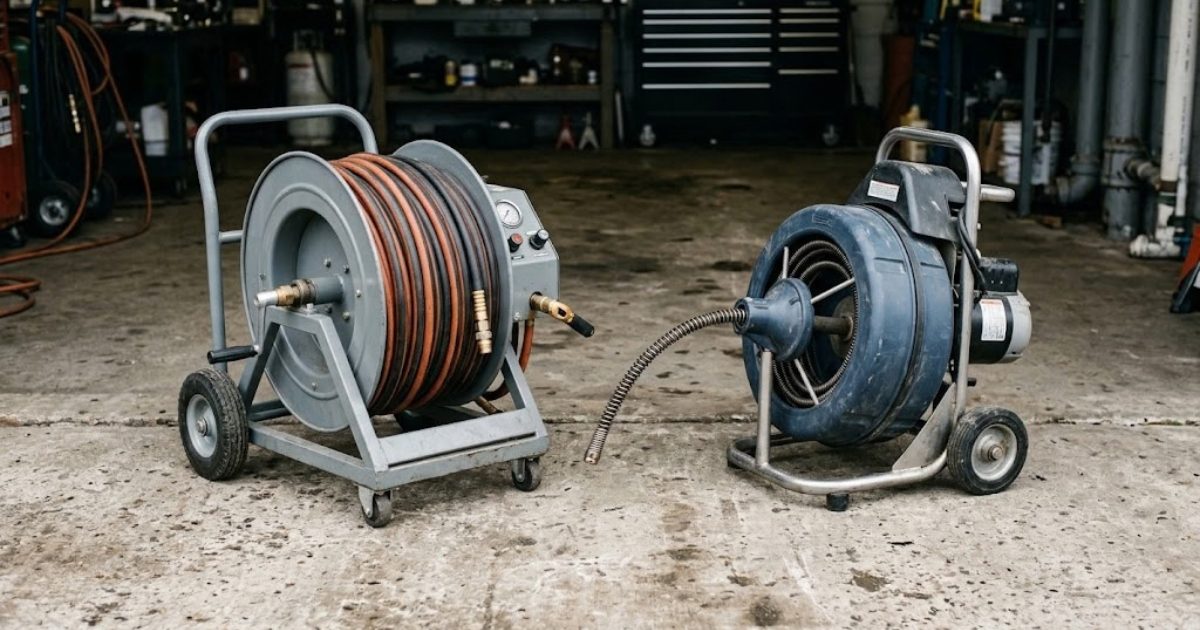
Two Real Tools, Two Different Jobs
Cable snaking and hydro jetting are both legitimate drain clearing methods, but they're built to solve different problems, and using the wrong one is a common reason a clog comes back a few weeks after it seemed fixed.
A Mechanical Approach
A cable snake uses a rotating metal cable with a cutting or grabbing head to physically break through or pull out a blockage. It's fast, effective for a single, well-defined clog, and generally the lower-cost option for a straightforward job.
A Full-Pipe Cleaning Approach
Hydro jetting uses a high-pressure water stream, often 3,000 to 4,000 PSI, to scour the entire interior wall of the pipe, not just punch through the immediate blockage. It removes grease buildup, mineral scale, and root intrusion along the full length treated, rather than just clearing a path through it.
Simple, Isolated Clogs
A single clog with no history of recurrence, especially in a fixture-level drain like a bathroom sink, is often well-suited to snaking. It's faster and less expensive when the problem really is that contained.
Recurring Clogs Or Root Intrusion
If the same drain has clogged more than once in a relatively short period, or a camera inspection shows grease buildup or root intrusion along the pipe wall, hydro jetting addresses the underlying buildup rather than just punching through it again. It's the more thorough, longer-lasting fix for these situations.
A Common, Reasonable Concern
Both methods are safe for standard residential pipe when performed correctly. The real risk is using hydro jetting on already severely compromised or very old, fragile pipe without first confirming its condition via camera, which is why a professional inspection before jetting matters for older lines specifically.
Why One Typically Costs More
Hydro jetting generally costs more than snaking because it takes longer, requires specialized equipment, and treats the entire pipe length rather than just clearing a path through one blockage. That higher upfront cost is often offset by not needing to repeat the service again in a few months for the same recurring clog.
Sometimes The Right Answer Is Both
In some cases, an initial snake clears an urgent blockage immediately, and hydro jetting is scheduled afterward as a more thorough follow-up once the immediate emergency is resolved. This staged approach makes sense when a drain needs to be usable again right away but also has a documented history of buildup worth addressing properly.
Why Location Changes The Calculus
A kitchen sink clog close to the fixture is usually a quick, low-cost snake job regardless of buildup history, since the affected section is short and easy to reach. A main line clog affecting multiple fixtures throughout the house is a different scale of problem, and that's where hydro jetting's ability to clean the entire line length matters more.
Not An Every-Visit Requirement
Hydro jetting isn't something a healthy drain needs repeated regularly. Once a line has been thoroughly cleaned, most homes go years before needing it again, assuming normal household use and no new root intrusion. It's a periodic deep clean, not a routine maintenance item like changing an air filter.
Seeing Before Deciding
A camera inspection before either method lets us actually see what's inside the pipe rather than inferring it from symptoms alone. That visual confirmation is often the difference between confidently recommending the right method the first time and guessing based on how often a drain has clogged.
A Preventable Contributor Worth Naming
Pouring cooking grease down a kitchen drain, even in small amounts over years, is one of the most common contributors to the buildup that eventually needs hydro jetting to fully clear. Cooling grease in a container and disposing of it in the trash is a small habit that measurably reduces how often this becomes an issue.
The Short Version If You're Skimming
Snaking is faster and cheaper for a single, isolated clog, while hydro jetting fully cleans a pipe's interior and is the better call for recurring buildup or root intrusion. A quick diagnosis, sometimes with a camera, tells us honestly which one your drain actually needs.
Common Questions
You can, but if a simple snake would resolve it, we'll tell you honestly rather than upsell a more expensive method you don't need.
Generally yes, though a camera inspection first confirms the pipe's condition can handle the pressure, especially on older, more corroded lines.
Snaking clears a path through a blockage but doesn't remove buildup along the rest of the pipe wall, which is exactly the kind of recurring pattern hydro jetting is built to address.
A typical residential hydro jetting job takes one to two hours, longer than a comparable snaking job, since it treats the pipe's full length rather than a single point.
For a home with a documented history of grease buildup, an occasional preventive jetting can make sense, though it isn't necessary for most healthy lines.
It's no more disruptive than typical plumbing work at the access point, and the rest of the house is unaffected during the process.
It can if the pipe is already severely compromised, which is exactly why we recommend a camera check first on older lines before jetting.
Not always, a lodged object sometimes needs mechanical retrieval rather than water pressure alone, which a camera inspection would reveal.
Yes, when the line's condition has been confirmed first via camera, which is exactly the precaution we take before recommending it on an older system.
We stand behind the work we do, and if the same issue returns unexpectedly soon after, we'll take a second look.
Related Services
The right method depends on what's actually causing the clog, not which one sounds more thorough. A quick diagnosis tells us which one your drain needs.