There's No Universally Right Answer
When a water heater fails, most homeowners default to replacing it with the same type they already had. That's often fine, but it's worth actually comparing tank and tankless options, especially in a market like Clearwater where hard water changes the math for both. Ten minutes spent comparing now can mean a meaningfully better fit for the next decade or two of hot water use.
How A Traditional Tank Works
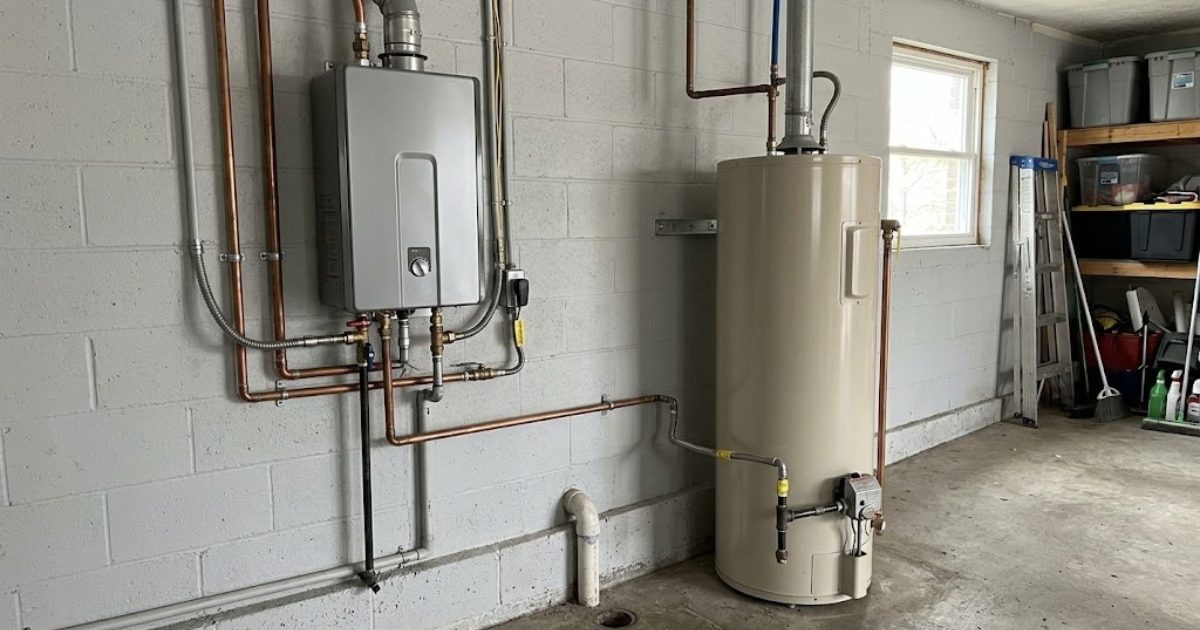
A tank water heater stores and continuously heats a set volume of water, usually 40 to 50 gallons for a typical household. It's simpler to install, costs less upfront, and is easy for most technicians to service, but it can run out of hot water during heavy simultaneous use, like back-to-back showers and a dishwasher cycle.
How On-Demand Heating Works
A tankless unit heats water as it flows through, rather than storing it. That means functionally endless hot water, since there's no tank to deplete, and it takes up far less physical space, usually mounted on a wall. The tradeoff is a higher upfront cost and a more involved installation, sometimes requiring updated venting or gas line sizing.
Why Local Water Chemistry Matters More Here
Both tank and tankless units are affected by Gulf Coast hard water, but differently. A tank accumulates sediment at the bottom, which a tankless unit doesn't. A tankless unit instead builds scale inside its heat exchanger, which requires periodic descaling to maintain efficiency, something that isn't optional in a hard water market like this one if you want it to last.
What To Actually Expect
A well-maintained tank unit typically lasts 10 to 15 years here, sometimes less if hard water buildup isn't addressed. A tankless unit properly descaled on schedule can last 20 years or more, but skipping maintenance in this water chemistry shortens that significantly.
What Actually Decides It
Household size and hot water demand patterns matter more than either option being universally "better." A single person or couple with modest hot water use often does fine with a smaller tank. A larger household running multiple showers and appliances at once benefits more from tankless. Budget for installation complexity matters too, since not every home is a simple swap for a tankless unit.
What Each Option Actually Takes Up
A tank unit needs a dedicated closet or utility space roughly the footprint of a large barrel, plus clearance for service access. A tankless unit mounts on a wall and takes up a fraction of that floor space, which matters in smaller homes or condos where utility closet space is at a premium.
The Ongoing Difference Beyond The Sticker Price
Tankless units only heat water on demand, rather than continuously maintaining a full tank at temperature, which typically translates to lower monthly energy costs. That gap narrows if a household doesn't use much hot water to begin with, since a tank isn't working especially hard to maintain temperature for a low-use household either.
A Separate Decision From Tank Vs. Tankless
Both tank and tankless units come in gas and electric versions, and that choice is somewhat independent of the tank-versus-tankless decision. Gas units generally recover hot water faster and cost less to run in areas with cheaper natural gas, while electric units are simpler to install where gas isn't already plumbed to the water heater location.
The Short Version If You're Skimming
Tank units cost less upfront and are simpler to install, tankless units deliver endless hot water and typically last longer, and hard water affects both differently enough that pairing either with a softener is worth considering. Household size and usage patterns should drive the decision more than either option's reputation.
A Reasonable Way To Settle It
If you're genuinely torn, describing your household's daily hot water routine to a technician during an inspection is more useful than reading further comparisons online, since a specific recommendation based on your actual usage beats a general one every time.
Rebates And Incentives Worth Asking About
Some utilities and manufacturers occasionally offer rebates for higher-efficiency tankless units, which can meaningfully offset the higher upfront cost. It's worth asking about current availability when you're ready to move forward, since programs change from year to year.
Common Questions
Yes, more than in a soft-water market. Periodic descaling keeps the heat exchanger efficient and extends its life significantly.
Often yes, but it depends on your existing gas line, venting, and electrical setup. We can assess that during an inspection.
Not necessarily. An oversized tank costs more to run and to buy than what your household actually uses, so matching capacity to real usage matters more than maximizing size.
Not always, tankless and high-efficiency tank units sometimes qualify for different programs, so it's worth asking specifically about your chosen option.
Not usually without modification, since tank and tankless units often have different venting requirements that need to be assessed during installation.
It can be, especially for electric-only homes, though it has its own space and climate considerations worth discussing during an inspection.
Tank units are generally simpler and quicker for a technician to service, while tankless units sometimes require more specialized parts and diagnostics.
Tankless can make sense there, since it uses no energy maintaining a full tank at temperature when the home sits empty for long stretches.
Yes, some larger homes use a hybrid setup, a tankless unit for one area and a tank for another, depending on layout and demand.
Related Services
Both options work well in Clearwater homes. The right one depends on your household's actual hot water habits, not which one sounds more modern, and we're happy to walk through the real tradeoffs for your specific situation over the phone, with every install completed to Florida Building Code plumbing standards.
Not Sure Which Fits Your Home?
Call and tell us your household size, we'll recommend honestly.
☎ Call (727) 931-8107